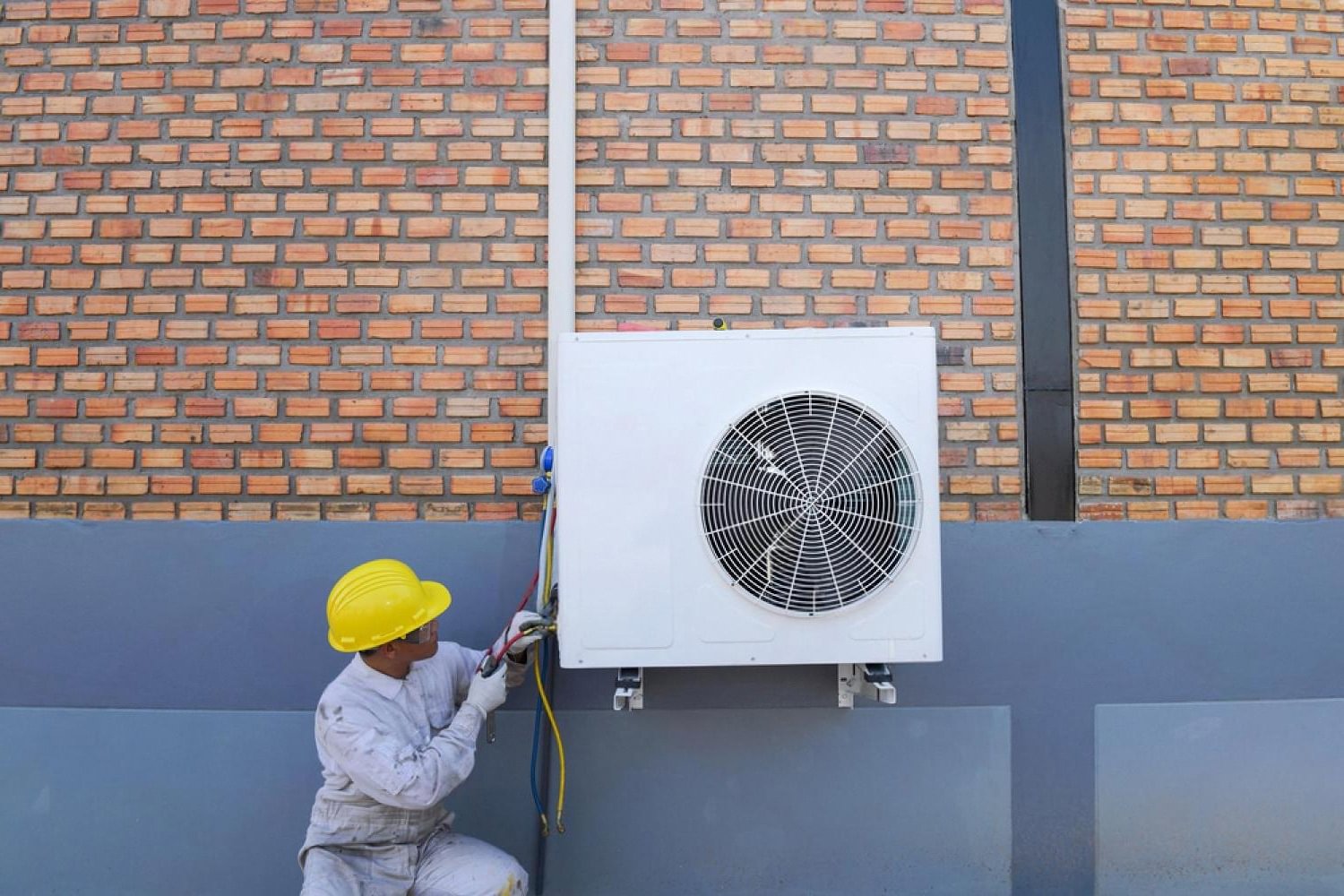
Case study, Al Quoz warehouse
A Dubai facility manager walked into 46 °C shop-floor readings and a queue of complaints about heat stress. The team had three window units, a couple of pedestal fans, and staff clocking out early. This is how they rebuilt the cooling plan from scratch, and what actually worked once summer hit.
Dubai does not forgive an undersized cooling system. Between May and September, outdoor temperatures regularly push past 45 °C and humidity along the coast climbs above 70 percent. Inside a commercial space, that translates to slower productivity, higher sick leave, and, in some sectors, real safety risk. The UAE Ministry of Human Resources enforces a midday work ban for outdoor labour every summer, and indoor employers are expected to keep working conditions safe too. Choosing the right cooling solution is less about buying the biggest machine and more about matching output to the room.
Before and after: the Al Quoz retrofit
Setup: 3 wall-split ACs (24,000 BTU each) trying to cool a 1,200 m² semi-open warehouse with 9 m ceilings.
- Shop-floor temperature: 42 to 46 °C by 11 am
- Staff productivity dropped roughly 30% after lunch
- Electricity bill spiked but perceived cooling was near zero
- Compressors iced up and tripped twice a week
Setup: 4 industrial evaporative air coolers on the shop floor, 2 spot coolers over the QC benches, and the original splits reassigned to the enclosed office.
- Shop-floor temperature: 28 to 31 °C, all day
- Zero heat-related incidents through the summer
- Energy use dropped by about 40% versus the AC-only plan
- Break area added, staff turnover fell noticeably
Step one
Understand the space before you shop for equipment
The biggest mistake in Dubai commercial cooling is buying by price or brand instead of by requirement. Before a single quote is sent out, the facility team should map four numbers for every zone.
- Total floor area in square metres, room by room, not the whole building as one lump.
- Ceiling height. A 9 m warehouse ceiling holds four times the air volume of a standard 2.7 m office of the same floor size.
- Environment typeindoor sealed, semi-open with loading doors, or fully outdoor. This one factor decides whether evaporative or refrigerant cooling makes sense.
- Occupancy and heat load. Number of people, plus machinery, ovens, servers, or lighting that adds heat.
Once these are on paper, a good supplier can calculate BTU or airflow requirements accurately. Guessing here is what leads to the iced-up compressors we saw in the case above.
What we tried first, and why it did not work
The initial instinct at the Al Quoz site was the same one most Dubai operators have: add more air conditioners. The team priced up six additional split units, then a rooftop package unit. Two things stopped the project.
- The building was semi-open. The loading bay doors stayed up for 6 hours a day. Refrigerant-based AC in a semi-open space is like leaving the fridge door open, it runs constantly and never wins.
- The ceiling was too high for splits. Cool air from wall-mounted units settled in a thin layer near the floor for about 10 minutes, then mixed back into the hot volume above. Occupants at head height felt almost nothing.
- The electrical load was already close to the limit. Adding six more compressors would have required a DEWA upgrade and a new distribution board, months of paperwork before any relief on the floor.
- Humidity was moderate, not extreme. Al Quoz sits inland, so ambient humidity in summer typically runs 30 to 45 percent, well within the range where evaporative cooling performs.
The lesson: sealed refrigerant AC is the right answer for offices, meeting rooms, and retail with closed doors. It is the wrong answer for warehouses, workshops, tented events, garages, and any space where outside air comes and goes freely.
What actually worked: matching the machine to the zone
The revised plan split the building into four cooling zones and picked a different tool for each. That is the core idea worth taking away from this case: a commercial site rarely needs one type of cooling, it needs the right mix.
- Portable air coolers for the outdoor smoking area and the covered loading bay. These use water evaporation to drop air temperature by 8 to 12 °C, they only need a power socket and a water top-up, and they work best exactly where AC fails, in ventilated or semi-open spaces.
- Portable air conditioners for the small enclosed meeting pod that gets used two hours a day. A permanent split would have been overkill. A wheeled 12,000 BTU portable AC covered it for a fraction of the install cost.
- Industrial air coolers for the main shop floor. Large-airflow units, some rated above 18,000 m³/h, moved enough cool air to actually change the shop-floor temperature. According to evaporative cooling principles these units use roughly 10 to 15 percent of the electricity of an equivalent AC output, which was the deciding factor for the finance team.
- Spot coolers for the QC benches and the server cupboard. Instead of trying to cool the whole room, a spot cooler throws a directed cold stream at a single workstation or piece of equipment. The QC staff got comfortable air on their faces, the servers stayed under 24 °C, and nothing else had to change.
What to ask a supplier
The four things a rental or purchase partner should handle for you
- Equipment recommendations based on your zone maps, not a generic catalogue push. If the first question is “what is your budget” instead of “how big is the space,” keep looking.
- Delivery and installation across Dubai on a scheduled window, ideally with same-day options for emergencies. Summer breakdowns cannot wait a week.
- Positioning advice on site. Where the intake sits, where the exhaust goes, and how far the airflow will reach all decide whether the machine actually helps.
- Technical support for the duration of the rental or warranty, including filter changes, water hookup checks, and refrigerant top-ups.
“The moment we stopped asking ‘which AC is strongest’ and started asking ‘what is happening in each corner of this building’, the whole project got cheaper and worked better. Cooling in Dubai is a zoning problem, not a horsepower problem.”
Bringing it together
Choosing the right cooling solution for a commercial space in Dubai involves more than simply selecting the largest unit. It starts with an honest audit of floor area, ceiling height, whether the space is sealed or open, and how many people and machines are inside. From there, the correct tool almost picks itself: portable coolers for airy spots, portable AC for small enclosed rooms, industrial coolers for warehouses and factories, and spot coolers for workstations and sensitive equipment. Get the zoning right, pair with a supplier who handles delivery, positioning, and support, and the summer stops running the business.
Frequently asked questions
What is the difference between an air cooler and an air conditioner in the UAE climate?
An air conditioner uses refrigerant gas to remove heat from a sealed room, and it works best when doors and windows are closed. An air cooler uses water evaporation to drop the temperature of the air passing through it, and it works best in ventilated or semi-open spaces.
In Dubai, that means AC is the right choice for offices, retail, and meeting rooms. Air coolers, especially industrial ones, are better for warehouses, workshops, outdoor events, and any space with open doors or high ceilings.
How do I calculate the cooling capacity my Dubai commercial space needs?
Start with the floor area in square metres, multiply by ceiling height to get the volume, then adjust for the number of people, machinery heat, direct sunlight, and how sealed the space is. For AC, capacity is measured in BTU. For evaporative coolers, it is measured in airflow (m³/h).
A rough rule for Dubai is around 700 to 900 BTU per square metre for well-insulated indoor commercial space, but ceilings above 3 metres, glass facades, or semi-open areas can push that up significantly. Ask a supplier to run the calculation properly rather than eyeballing it.
Is it better to rent or buy commercial cooling equipment in Dubai?
Renting makes sense for temporary sites, event cooling, construction phases, or short summer peaks where you only need extra capacity for a few months. It also avoids storage headaches during the cooler part of the year.
Buying makes sense for permanent installations in offices, retail, and warehouses that need the same output every summer for years. Many operators use a hybrid approach: they buy the core system and rent extra portable or spot units when a specific project needs a boost.
Do evaporative air coolers work well in Dubai’s humidity?
They work well in inland Dubai (Al Quoz, Dubai Investments Park, Jebel Ali industrial zones) where summer humidity often stays between 30 and 50 percent. In these conditions, an industrial cooler can drop air temperature by 8 to 12 °C.
Along the coast, especially in August and September, humidity can climb above 70 percent and evaporative cooling becomes less effective. For coastal sites with high humidity, refrigerant AC or a hybrid setup is usually the better answer.
What is a spot cooler and when should I use one?
A spot cooler is a portable refrigerant-based unit that pushes cold air in a directed stream at a specific target instead of trying to cool a whole room. Common uses in Dubai include cooling individual workstations on a shop floor, keeping small server rooms under temperature limits, and providing emergency cooling when a main AC fails.
They are the right choice when you need a small, precise cold zone inside a larger space that either does not need cooling everywhere, or would be too expensive to cool everywhere.
How much does commercial cooling installation typically cost in Dubai?
Costs vary widely depending on the type of equipment, the size of the space, and whether ducting or electrical upgrades are needed. Portable units are the cheapest to deploy because they only need a power socket. Ducted split systems and rooftop packages are the most expensive because of the civil and electrical work involved.
Rather than a fixed number, ask suppliers for an itemised quote that separates equipment, delivery, installation, and ongoing service. That makes it much easier to compare offers fairly.

Soccer lover, vegan, DJ, Saul Bass fan and fullstack designer. Working at the crossroads of art and sustainability to craft delightful brand experiences. Let’s design a world that’s thoughtful, considered and aesthetically pleasing.